
People usually search court dockets to check case updates, hearing dates, or filings related to a legal matter. A missed hearing date, an unread filing, or a misunderstanding can lead to serious consequences. Court systems often use technical language that can be difficult for first-time users to understand.
This guide explains what a court docket is, how to search it, and how to read the information correctly and what it can and cannot tell you, without confusion or unnecessary complexity. If you’re trying to track a case quickly, understanding how the docket works can save you from serious mistakes.
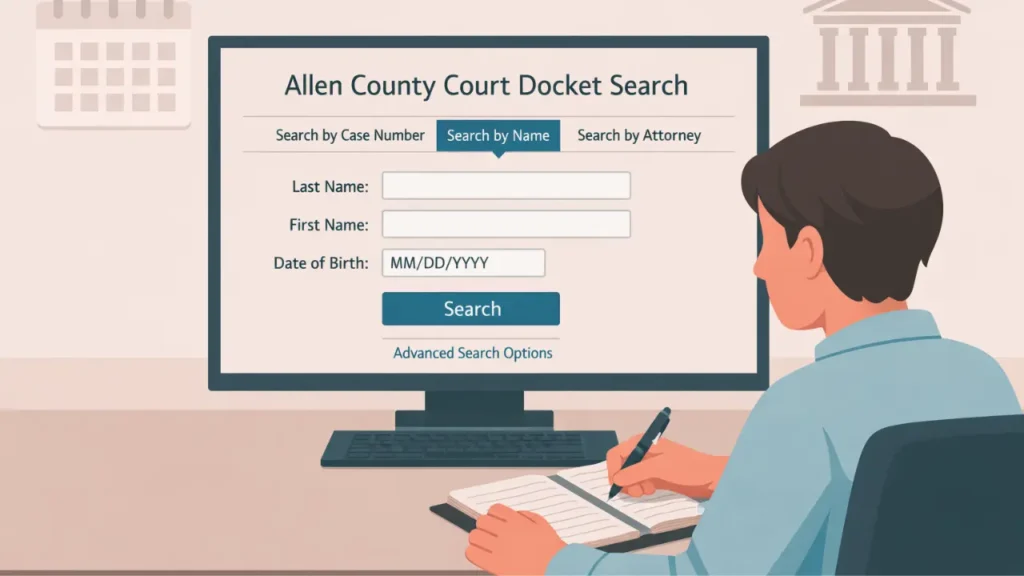
What Is an Allen County Court Docket?
A court docket is a timeline of a court case, not the case itself. It is a running list that shows what has happened in a case and what is scheduled next. Every filing, hearing, motion, or update is logged there in chronological order. It only records case activity, not the final outcome or complete court file.
This is different from a case summary, which gives a brief overview, and different from a judgment, which shows the final decision. A docket also differs from full court records because it does not always include the actual documents, just references to them. Understanding this difference alone prevents a huge amount of confusion when people expect answers the docket was never meant to provide.
Are You Searching the Correct Allen County?
There is more than one Allen County in the United States, and this mistake is incredibly common. Allen County exists in Ohio, Indiana, Kansas, and other states. Court systems are managed at the county level, so selecting the correct county is important for accurate results.
This article refers specifically to Allen County, Ohio. Court dockets here are maintained by the Allen County Clerk of Courts, not the Sheriff, Auditor, or Treasurer. Jurisdiction matters because each county runs its own courts, databases, and record rules. If the portal does not clearly say “Allen County, Ohio,” you are likely in the wrong place.
Using the Allen County Court Docket Search Tool
The Allen County Clerk of Courts is the official office responsible for court dockets. Their online portal is the correct and legal starting point for searching court activity. This system includes multiple courts, such as the Court of Common Pleas, Municipal Court, and Domestic Relations Court.
Third-party websites often scrape partial data or delay updates, which is why information there may look outdated or incomplete. Starting with the Clerk of Courts saves time and avoids misinformation. Once inside the official portal, all searches follow the same basic structure, even though each court may display information slightly differently.
What Information You Need to Search Successfully
The most reliable way to search a docket is by case number, but most people do not have that. Name searches are common, but they require accuracy. Legal names work better than nicknames, and spelling matters more than expected. Searching by attorney name or filing date can also work if personal details are limited.
If information is incomplete, combining fewer search filters usually helps. Adding too many filters can sometimes reduce search results instead of improving them. The system is built for precision, not guesses, so simple inputs often work better than detailed ones.
Why Your Case Is Not Showing Up
Not finding a case does not always mean it does not exist. New filings may take time to appear online, especially after hours, weekends, or holidays. Some cases are legally sealed, such as juvenile matters or sensitive proceedings, and will never show publicly.
In other situations, the case may be filed under a slightly different name or transferred to another court. Understanding that public access has legal limits helps reduce panic when results are missing.
How to Read and Understand Docket Entries
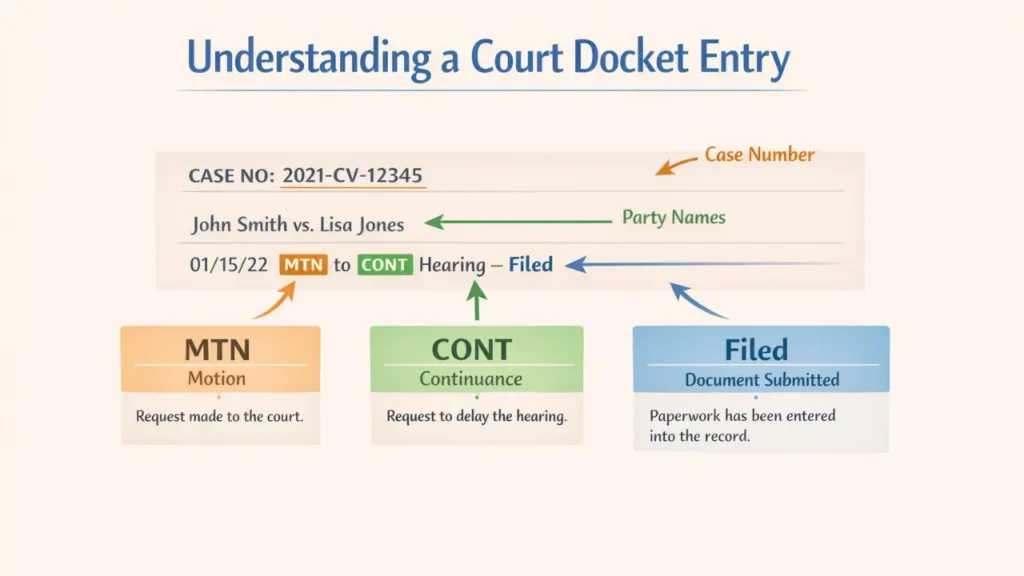
Once you find a docket, the entries often look like coded messages. Abbreviations, filing titles, and short notes can feel unreadable. Each line usually represents an action taken, such as a motion filed, a hearing scheduled, or a continuance granted.
Example:
A docket entry reading “Motion for Continuance Granted” simply means a scheduled court event was postponed, not that the case was decided or dismissed.
Understanding basic terms like “motion,” “filing,” “order,” and “continuance” turns the docket from noise into useful information.
Finding Hearing Dates and Important Deadlines
Court dockets are critical for tracking upcoming hearings and deadlines. Hearing dates are usually listed near the most recent entries or under a scheduling section. These dates can change, so checking the docket regularly is important.
Pro tip: Always recheck the docket 24–48 hours before a hearing. Last-minute changes happen more often than people expect, and missing an update can have serious consequences.
How Official and Updated the Information Is
Docket information provided by the Clerk of Courts is official, but it is not always real-time. Updates may lag due to processing delays, court workload, or technical maintenance. This does not mean the information is wrong, only that it may not reflect events from the same day. Because of this, court staff often advise confirming urgent matters directly with the Clerk’s office if timing is critical.
Getting Copies of Docket Filings
A docket shows that a document exists, not always the document itself. To obtain copies, users may request them through the Clerk of Courts. Some documents are available online, while others require in-person or written requests.
Fees depend on whether the copy is certified and how it is delivered. Certified copies are commonly required for legal proof, while informal copies may be sufficient for personal records.
What You Should Not Rely on a Court Docket For
A court docket does not explain legal strategy, predict outcomes, or replace legal advice. It also may not immediately show final judgments or private filings. Treating the docket as guidance rather than authority prevents dangerous assumptions. When legal interpretation or consequences matter, contacting an attorney or the Clerk of Courts is the correct next step.
Sample Docket Entry Breakdown
A typical docket line might include the filing date, document title, and brief status note. Reading it left to right usually shows when something happened, what happened, and whether action is pending or complete. This simple approach makes most entries understandable without legal training.
Allen County Court Docket Basics
Use this checklist to avoid common court docket search mistakes:
| Item | What It Means | Why It Matters |
|---|---|---|
| Court Docket | Timeline of all case activity | Shows what happened and what’s next |
| Case Number | Unique case identifier | Fastest way to find a docket |
| Filing | Document submitted to court | Indicates action taken |
| Motion | Formal request to judge | Can change case direction |
| Continuance | Hearing delay | Explains schedule changes |
| Hearing Date | Scheduled court appearance | Missing it can create legal complications. |
| Clerk of Courts | Official record keeper | Only trusted source |
How to Use an Allen County Court Docket Correctly
Use this before you panic or assume something went wrong:
- Confirm you are searching Allen County, Ohio, not another state
- Start with the Clerk of Courts official website
- Use case number if available, otherwise legal name
- Avoid nicknames or partial spellings
- Check if the case may be sealed or juvenile
- Look for the latest docket entry, not the first one
- Recheck hearing dates within 48 hours of court
- Request certified copies if you need legal proof
- Call the Clerk if timing is urgent or unclear
- Do not rely on third-party lookup sites for accuracy
Conclusion:
Once you know how to read a docket, it becomes much easier to track case updates and understand what is happening. You know what they show, what they hide, where to search, and how to read them responsibly. Instead of guessing, panicking, or relying on third-party sites, you can track court activity accurately and know when to seek further help. That clarity alone saves time, stress, and serious mistakes.
FAQs
Is an Allen County court docket free to access?
Yes, you can usually access docket information for free through the Clerk of Courts.
Can I search a docket using only a name?
Yes, but legal names and correct spelling greatly improve search results.
How often are court dockets updated?
Updates are frequent but not always real-time, especially after hours or holidays.
Do dockets show final case outcomes?
Sometimes, but final judgments may appear later than hearings or filings.
Are all court cases visible to the public?
No. Juvenile, sealed, and certain sensitive cases are restricted by law.
Can I rely on the docket instead of calling the court?
For general information, yes. For urgent or unclear matters, contact the Clerk directly.
